Imagine meeting someone truly unforgettable. Not just a face in the crowd, but a person with a history you sense, a personality that intrigues, and motivations that make you lean in to hear more. That's the power of truly developed main characters and the profiles that bring them to life in your fiction. Without them, your stories risk feeling hollow, your plots falling flat. But with a robust character profile, you transform mere names on a page into living, breathing individuals who captivate readers and drive your narrative forward.
This isn't about rote paperwork; it's about deep understanding. It's about knowing your characters so intimately that their actions feel inevitable, their reactions authentic, and their journey compelling.
At a Glance: Crafting Characters That Stick
- Go Beyond the Surface: Great characters aren't just names and faces; they have rich inner lives and complex histories.
- The "Skin, Flesh, Core" Framework: Build your characters from the outside in—physicality ("Skin"), backstory ("Flesh"), and most critically, their deep-seated psychology and motivation ("Core").
- A Living Document: Character profiles aren't static. Update them as your characters evolve throughout the writing process.
- Solve Plot Holes & Inconsistencies: Profiles act as your continuity guide, ensuring characters stay true to themselves from beginning to end.
- No More "Flat" Characters: Use profiles to uncover new facets, hidden traumas, unique skills, or deadly secrets that make your characters three-dimensional.
- Your Process, Your Rules: The level of detail is flexible; find what works best for your creative process.
Why Character Profiles Are Your Story's Secret Weapon
Think of a character profile not as a tedious chore, but as an essential tool—your character's detailed biography. It’s where you record everything from their age and appearance to their deepest fears and most fervent desires. This isn't just a convenient place to stash information; it's the crucible where you forge individuals who feel genuinely alive.
The purpose is beautifully simple, yet profoundly impactful. First, it empowers you to craft characters that are as vivid, lifelike, and three-dimensional as possible. When you know a character inside and out, their dialogue rings true, their choices make sense, and their struggles resonate. You move beyond stereotypes and into nuanced portrayals. Second, a well-maintained profile is your guardian against continuity errors. Ever forgotten if your protagonist was a natural redhead or dyed blonde? Or whether they had a sibling at the story's start? Your profile keeps these details consistent, especially crucial in complex novels with multiple main characters, shifting points of view, or specific genre elements like unique magical abilities or intricate past motivations.
Profiles are particularly invaluable during the rewrite stage. They help you double-check that every action, every decision, every attribute remains consistent with the character you've built, ensuring your reader never stumbles over an unexplained shift in personality or a forgotten detail.
The Three Layers of a Living Character: From Surface to Soul
To build a truly compelling character, consider them in layers, much like an onion, or more aptly, a living being. The most effective profiles delve into three conceptual depths: the "Skin," the "Flesh," and the foundational "Core."
Beyond the Surface: "Skin" (Physical Appearance & Mannerisms)
This is the outermost layer, what an observer would notice immediately. It covers not just static physical traits but also how your character carries themselves, their habits, and their unique quirks. "Skin" helps you concretely identify the character and provides immediate visual cues for your reader.
- Visual Identifiers: Height, weight, race, eye color, hair color (natural vs. dyed), skin color, shape of face.
- Distinguishing Features: Scars, tattoos, birthmarks, unique jewelry, specific clothing style, glasses/contacts.
- Mannerisms & Habits: How they walk, talk, gesture; nervous tics, signature expressions, posture. Do they bite their nails? Always wear a particular hat?
- Health & Style: General health, any disabilities, their overall fashion sense (grungy, polished, practical, flamboyant).
This layer isn't just for description; it often hints at deeper truths. A character's meticulous grooming might suggest a need for control, while faded, comfortable clothes could speak to a practical, unpretentious nature.
The Echoes of Their Past: "Flesh" (Backstory & Formative Influences)
Just like real people, your characters are products of their pasts. This layer explores the people, circumstances, and formative experiences that have shaped who they are today. It’s the history that explains their present.
- Early Life & Family: Birth order, siblings, parents, grandparents, spouse, children, significant others. What were their relationships like?
- Hometown & Current Residence: Where did they grow up? How did that environment influence them? Where do they live now, and why?
- Socioeconomic Level & Background: Were they raised in poverty, comfort, or something in between? How has this impacted their outlook and opportunities?
- Key Life Events: Major triumphs, profound losses, pivotal choices, moments of trauma or joy. These are the turning points that etched themselves into their psyche.
- Education & Occupation: What did they learn? What do they do for a living, and how did they get there? What does their work reveal about them?
Understanding the "Flesh" helps you build a character with a believable history, preventing them from feeling like they simply materialized on page one. It provides the context for their current struggles and aspirations.
The Unshakable Truth: "Core" (Psychology, Motivation & Raison d'être)
This is the most critical layer, the absolute bedrock of your character. The "Core" defines who your character is deep down—their fundamental beliefs, their driving desires, their greatest fears, and their ultimate purpose. This is where their story goal originates and what truly drives their every action and reaction. Without a strong "Core," your character will drift aimlessly, and your story will lack direction.
- Greatest Flaw & Best Quality: These are often two sides of the same coin, revealing inherent conflicts and strengths.
- Self-Perception vs. Others' Perception: How do they see themselves? How do others see them? The tension between these views can be a goldmine for conflict.
- Short-term & Long-term Goals: What do they want right now? What do they truly aspire to achieve in life?
- Motivations: What truly pushes them forward? Is it love, fear, revenge, justice, survival, acceptance, power?
- Fears & Happiness: What frightens them most? What brings them genuine joy? These are powerful emotional triggers.
- Emotional Responses: How do they typically deal with anger, sadness, conflict, change, or loss? Are they stoic, explosive, withdrawn?
- Inner Conflict: Are they ruled by emotion or logic? What would most embarrass them? What would they change about their life?
- Moral Compass: Are they judgmental or accepting? Generous or stingy? Polite or rude? What are their fundamental values?
The "Core" is the engine of your story. It dictates their choices, creates their conflicts, and ultimately informs their entire journey. It’s what makes a character resonate deeply with a reader because it taps into universal human experiences.
Crafting Your Character's Blueprint: Key Profile Elements
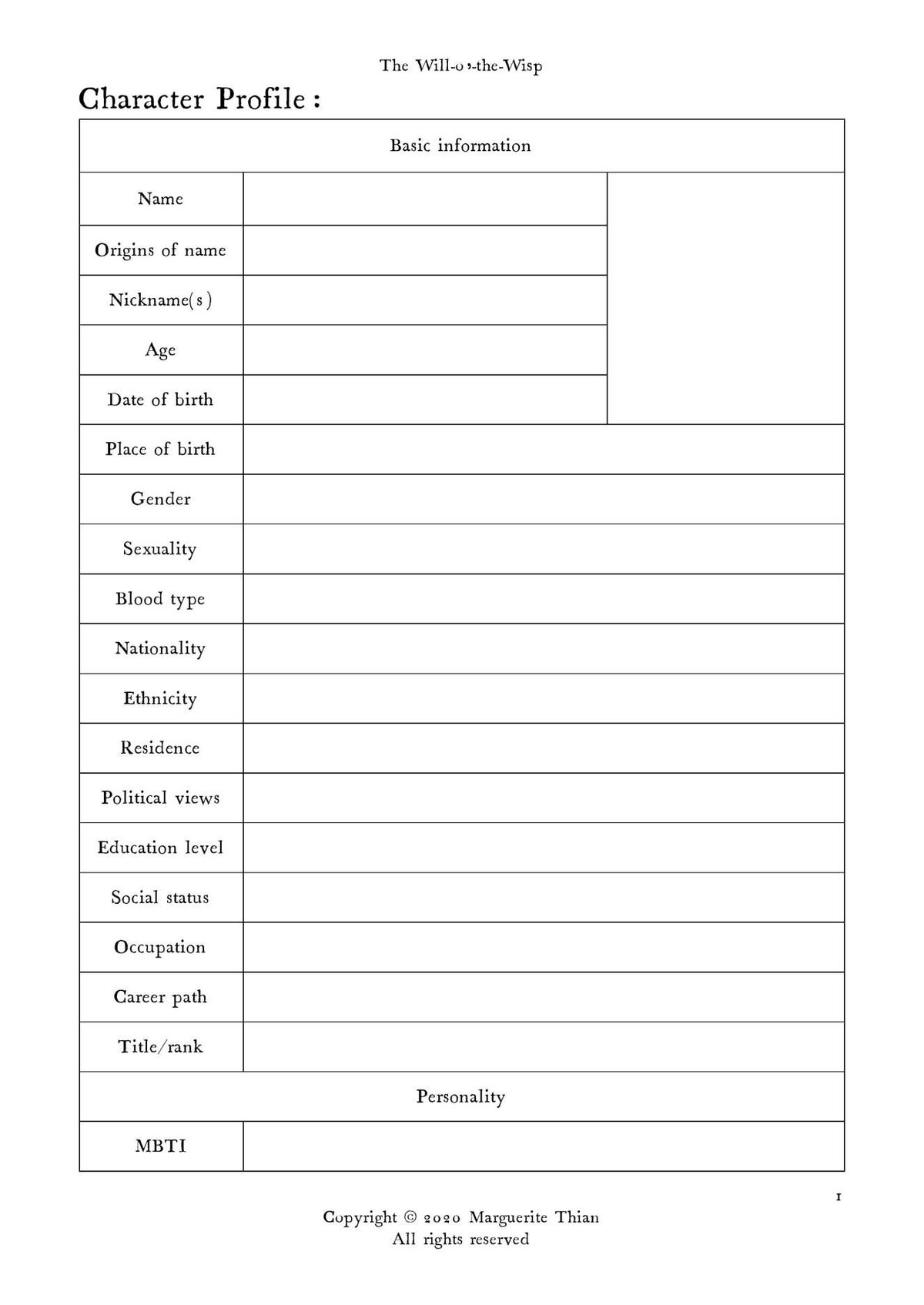
Once you understand the layers, it's time to populate them with specific details. A comprehensive character profile worksheet helps ensure you cover all your bases, preventing you from missing crucial elements that could make your character more robust.
The Nuts and Bolts: Basic Statistics
These are the essential facts that ground your character in reality.
- Identity: Full Name, Age, Nationality, Hometown, Current Residence.
- Life Circumstances: Socioeconomic Level (child/adult), Occupation, Income, Salary.
- Relationships: Birth order, Siblings, Spouse, Children, Grandparents, Grandchildren, Significant Others, Relationship skills (Are they good at connecting? Do they push people away?).
- Skills: Talents, special skills, unique abilities.
A Face for the Page: Physical Characteristics
Go beyond simple descriptions. How do these traits impact their life?
- Appearance: Height, Weight, Race, Eye Color, Hair Color, Glasses or contact lenses, Skin color, Shape of Face.
- Defining Marks: Distinguishing features (scars, tattoos, birthmarks).
- Presentation: How they dress (always formal? practical? trendy?), their signature style.
- Physical Habits: Mannerisms (fidgeting, hand gestures), Habits (nail biting, hair twisting), Health (chronic conditions, general fitness).
- Communication: Favorite Sayings, Speech patterns (accents, stutter, fast-paced).
- Limitations: Disabilities (physical or mental) and how they cope.
The Inner Compass: Core Qualities & Driving Forces
These are the fundamental truths about your character.
- Fundamental Traits: Greatest flaw, Best quality.
- Ambition: Short-term goals, Long-term goals, What they want out of life, What they'd change in their life.
- Internal Fire: Motivations (what truly drives them).
- Fear & Joy: What frightens them, What makes them happy.
Mind Games & Mental Landscapes: Intellectual & Personality Attributes
How does your character think and interact with the world?
- Education & Intellect: Educational Background, Intelligence Level.
- Challenges: Mental Illnesses (if applicable), Learning Experiences (how do they acquire new knowledge?).
- Self-Awareness: Self-perception, How perceived by others.
- Confidence: Self-confidence level.
- Decision Making: Ruled by emotion or logic.
- Vulnerability: What would most embarrass this character?
The Heart of the Matter: Emotional Characteristics
Explore the emotional landscape that colors their every interaction.
- Strengths & Weaknesses: Emotional resilience, triggers.
- Social Orientation: Introvert or Extrovert.
- Coping Mechanisms: How they deal with anger, sadness, conflict, change, loss.
- Moral & Ethical Stance: Judgmental or not, Generous or stingy, Polite or rude.
A Guiding Light (or Shadow): Spiritual Characteristics
For many, spirituality plays a significant role. Even the absence of belief is a characteristic.
- Belief System: Belief in God or a higher power, specific spiritual beliefs.
- Influence: The role of religion/spirituality in their life (guiding principles, source of conflict, comfort).
Their Role in the Grand Scheme: Story Involvement
How does this character fit into your story?
- Story Role: Main character, hero, villain, mentor, comic relief, etc.
- Debut: Scene of first appearance.
- Interactions: Relationships with other characters (and how these change over the course of the novel).
- Transformation: How the character is different at the end of the novel compared to the beginning (their arc). This is crucial for a compelling narrative.
Putting Your Profiles to Work: Practical Strategies for Writers
Knowing the elements is one thing; using them effectively is another. Here's how to make your character profiles active, dynamic tools in your writing arsenal.
Keeping Them Alive: Dynamic Profiles, Not Static Files
A character profile isn't a tombstone marking the end of your character's development. It's a living document. As you write, your characters will reveal new facets of their personality, make unexpected choices, or even change their minds. Always keep your character profiles updated. If your stoic detective suddenly cracks a joke, make a note of why—did they find a new emotional outlet? Meet someone who brings out their lighter side? This iterative process ensures your characters grow organically alongside your story.
When Your Character Feels Flat: Injecting Life
We've all been there: a character just isn't "working." They feel like a cardboard cutout, predictable, or worse, a "Mary Sue" (a character who is too perfect, too capable, or lacks significant flaws). If you find yourself stuck, go back to your profile. Consider adding a new, unexpected characteristic: a hidden trauma they've suppressed, a unique and obscure skill, or a deadly secret they're desperate to keep hidden.
For example, your seemingly perfect hero might have a debilitating fear of heights, or your gruff antagonist might secretly feed stray cats. These contradictions and nuances make a character feel real, adding depth and unpredictability. It's often the small, humanizing details, or the complex internal struggles, that truly bring them alive. Think about the rich, varied personalities in Meet the Big City Greens characters, each with their own quirks and motivations that make them memorable and relatable. These are the details that build empathy and connection.
Tailor-Made Tools: Finding Your Perfect Level of Detail
There's no one-size-fits-all approach to character profiling. Some writers thrive on exhaustive, multi-page documents that detail everything from blood type to favorite breakfast cereal. Others prefer a minimalist approach, sketching out only the most crucial "Core" elements and letting the rest unfold during the drafting process.
The level of detail depends entirely on what works best for you and your individual writing process. Experiment! Start with a comprehensive template, then pare it down or expand upon it based on what makes your characters come alive and your story flow. The goal isn't to fill out every blank, but to gain clarity and understanding.
Consistency is King: Profiles for Rewrites and Revisions
When you're knee-deep in rewrites, especially for a long novel, it's easy to lose track of minor details or even significant character traits introduced much earlier. This is where your character profile becomes your best friend. Use it as a checklist to ensure:
- Attribute Consistency: Does your character's appearance, skills, and background remain constant unless a specific plot point dictates a change?
- Action Consistency: Do their decisions and reactions align with their established personality and motivations (their "Core")?
- Voice Consistency: Does their dialogue reflect their education, personality, and emotional state?
A solid profile acts as your continuity bible, saving you from embarrassing inconsistencies and making your revision process smoother and more effective.
Your Character Profile FAQs
It's natural to have questions when diving into something as fundamental as character development. Here are some common queries, answered concisely.
How Long Should a Character Profile Be?
There's no magic number. It can range from a few bullet points for a minor character to a dozen pages or more for a protagonist. The length is dictated by the character's importance to the story and your personal writing style. Focus on quality and utility over sheer quantity. If a detail helps you understand them better, include it. If it feels like busywork, reconsider.
Do I Need a Profile for Every Character?
For every main character, absolutely yes. For significant secondary characters, a detailed profile is highly recommended, especially if they have an arc or play a crucial role. For minor, "walk-on" characters, a few quick notes on their most defining physical trait or personality quirk might suffice. Prioritize based on their impact on the plot and other characters.
When Should I Create a Character Profile?
Ideally, you should start developing your character profiles before you begin writing your story. This foundational work provides a roadmap. However, character development is an ongoing process. You'll likely refine and expand your profiles as you discover new aspects of your characters during the drafting phase. It's a cyclical process: outline, write, revise, and update the profile accordingly. Don't be afraid to revisit and adapt!
Bringing It All Together: Your Next Steps to Deeper Characters
Creating robust main characters through detailed profiles isn't just an exercise; it's an investment in your story's success. It's the difference between a cast of forgettable names and a vibrant ensemble that lives on in your readers' minds long after they've turned the final page.
Now that you have a comprehensive understanding of what goes into a character profile and why it matters, here's your actionable next step:
- Choose a Template (or Create Your Own): Use the layers and elements discussed here as a guide. You can find many free templates online, or simply start with a document outlining "Skin," "Flesh," and "Core," then fill in the detailed points beneath each.
- Pick Your Next Character: Start with your protagonist, or perhaps a challenging secondary character you're struggling to understand.
- Dive Deep: Don't just list facts. Ask "why?" Why is their greatest flaw x? How did their backstory lead to their current motivation? Push beyond the surface.
- Write! The ultimate test of a good character profile is how it informs your writing. Let your newfound understanding guide their dialogue, their actions, and their internal thoughts.
Remember, the goal is to know your characters better than you know some of your real-life friends. When you achieve that, your readers will feel like they're meeting someone truly unforgettable, and your fiction will pulse with life.